
Update 2/15/26: Due to Hubpages shutting down, I am moving my articles back to this blog. Any errors found in the original have been fixed.
On art used for book covers
I never really commented on the art used on the covers of the books I have reviewed. I have decided to change that. In my edition of Wolf Hall, the cover has two different cropped portraits of King Henry and Anne Boleyn. According to the back of the book, Henry’s portrait is by Hans Holbein, and Boleyn’s portrait is by Edouard Cibot. Yet, when I was searching for the complete Holbein portrait (as credited on the back cover), I noticed that the cropped cover version did not match the portraits I found attributed to Holbein. It did match a portrait attributed to the artist Joos van Cleve. Then I tracked down the source the book cites where the image originated and I could not find anything except for this link, which has the Joos van Cleve portrait of King Henry. I told my mother of my findings, and she said I should contact the publishing company, so I did. I informed MacMillan of what I found (I read it out loud to my mom to make sure I was articulate and polite), and they replied that they passed my email to the editor. In the email, I combined what I wrote in this article and then later added more information from my email to this review. If I receive a reply from the editor, I’ll update this article.
Now, let us explore the paintings themselves. These two artworks originate from two different eras, and it shows. Cleve’s rendering of King Henry has this stoic quality while Anne’s portrait is anything but stoic. (Update 4-26-18) Also, according to the information in the link embedded in the last sentence, the production designers may have cropped the wrong woman found in the Cibot portrait. When I published this, I didn’t know how to explain it (End update). To rehash, while King Henry is stately, Cibot’s Boleyn is distressed while housed in the Tower of London.
By contrast, the edition I have of Bring Up The Bodies features a portrait of Anne Boleyn with her letter B pendant on the cover. Her face is expressionless and contains no foreshadowing of the trouble she will find herself in Mantel’s reenactment of her life.
Compare and contrast Joos van Cleve’s portrait of King Henry to…

Joos van Cleve, Public domain, via Wikimedia Commons
…”Anne Boleyn in the Tower” by Édouard Cibot, 1835
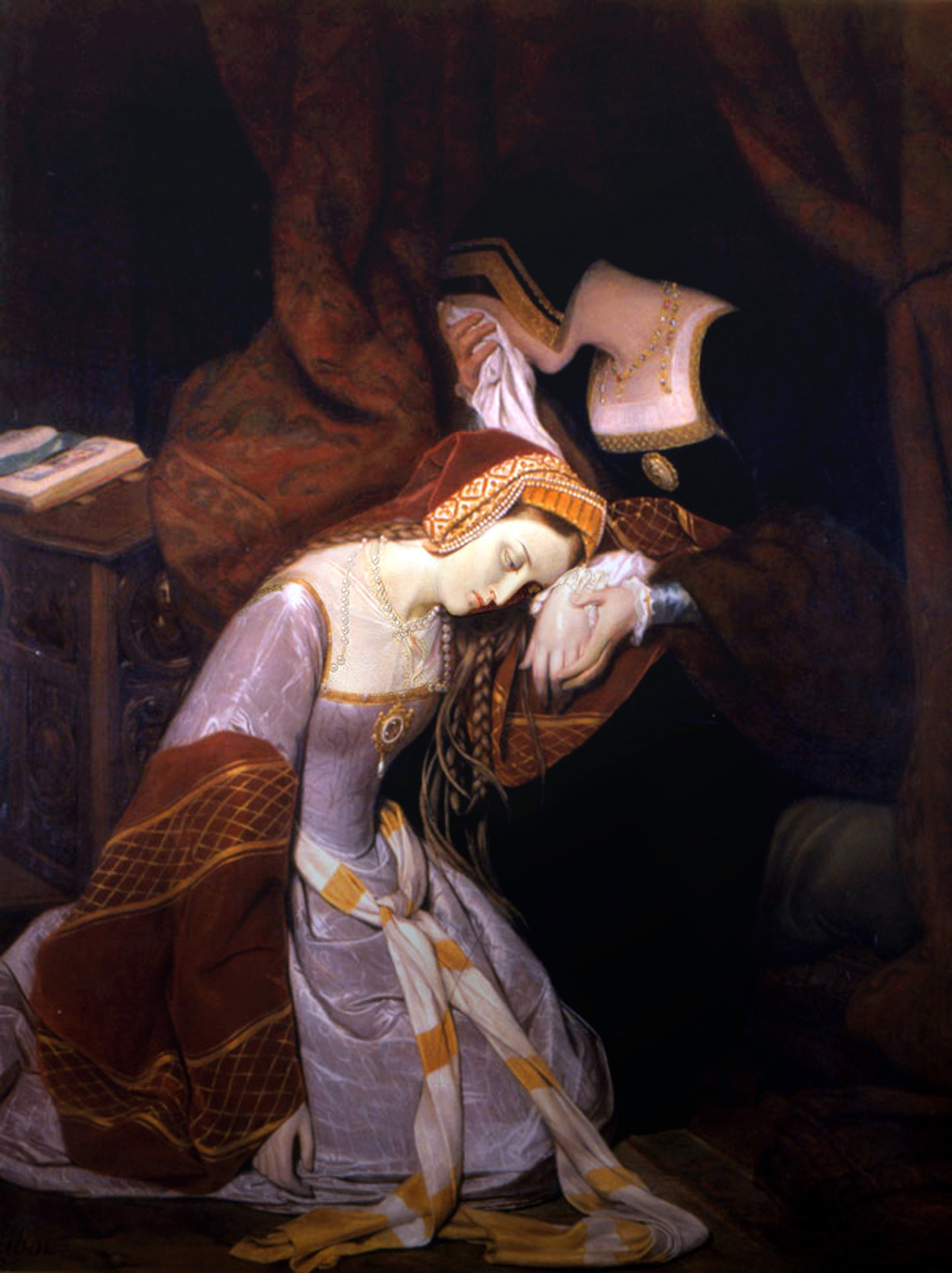
musée Rolin [Public domain], via Wikimedia Commons
{{PD-1923}}
The Continuing Adventures of Thomas Cromwell
The political adventures of Thomas Cromwell continues as the book counts down to Anne Boleyn’s fall and execution.
Honestly, I think her fall began in the first novel when the final line name drops Wolf Hall, the home of Jane Seymour.
As Anne desperately tries to birth a son and Cromwell starts taking down the people who destroyed his mentor Cardinal Wolsey, art history references occur. Compared to Wolf Hall, Mantel does not use as many references in Bring Up The Bodies. That’s just my opinion.
Hans Holbein, and the debate of truth in art
In Bodies, Hans Holbein has a much bigger role compared to his almost ephemeral presence in Wolf Hall. Holbein is seen as having a friendly, if teasing friendship with Cromwell. Furthermore, he is still working as an artist, and his relationship with the truth is fascinating to read. For example, Rafe Sadler complained that Holbein captured a facial flaw in his commissioned portrait. Cromwell contemplates his portrait and how Holbein depicts his handling of paper. The link I embedded has an analysis of the portrait that’s similar to Mantel’s descriptions in the series. Cromwell remembers the way Holbein has him pose and notes how the painting’s reproductions has now spread throughout Christendom and has crystallized his reputation as a man not to be trifled with. After that paragraph depicting Cromwell as an intimidating figure, Holbein’s portrait of the king is framed as sweet. Seriously, the description of the painting called to mind of some nature scene as found in an animated Disney movie.
Amusingly, Holbein complains of the flawed faces of the people who hire him to paint portraits of them. I can only speculate whether or not this will act as foreshadowing to the third and final book of Mantel’s Thomas Cromwell trilogy.
The Return of Biblical Art
Cromwell, basking in his love and patriotism for England, contemplates a series of decaying sculptures depicting knights from an early era. Mantel doesn’t divulge any more information behind the series, but Cromwell uses the artworks to muse on the constant rewrites of history that surfaces out of a sense of self preservation.
Mantel affirms this point in the first two books of her trilogy. In my review of Wolf Hall, I noted that art referencing Ancient Rome acted as a new era with the coronation of Anne Boleyn and the divorced Catherine of Aragon’s severe religious art is erased. In Bodies, after Boleyn’s reign falls apart, the Biblical art emphasized during Catherine’s reign as queen returns when Jane Seymour moves up in King Henry’s favor. During Jane’s ascension, people immediately denounce Anne Boleyn’s era of fashion and culture.
In Wolf Hall, Mantel used Queen Sheba as an allegory for Boleyn, but in Bodies, characters mockingly compare her to Queen Esther, and mentions a tapestry owned by King Henry showcasing the Biblical Queen. Dealing with a fire that occurred in Queen Anne’s room, King Henry and Cromwell discuss a painting (or a mural) of a rather vivid scene of Absalom’s death and contorted face.
When visiting Catherine of Aragon at Kimbolton Castle, her final place, Cromwell observes the many installations surrounding the former queen. He observes Kimbolton’s architectural flair and art connected to the woman imprisoned. He describes paintings of saints of dramatic and fantastic imagery. He sees a painting depicting Saint Edmund. The link explains that this saint was present during the signing of the Magna Carta. An “oak screen” has a rendering of Saint Anne and Mary, and Saint Michael in battle with an adversary of Hell. Cromwell sees other scenes of Adam and Eve before their exile from Eden. In this atmosphere of righteous saints who stood up to kings with too much power, canonized mothers and soon-to-be holy mothers, celebrations of innocence, Cromwell wonders if Katherine is nostalgic for her Alhambra days. Even King Henry has a luxurious decoration of Saint Hubert on his person. Regarding Jane, Cromwell even compares Seymour’s downcast eyes to the modest women he’s seen illustrated in art.
While Katherine died, surrounded by representations of saints and Adam and Eve in the garden, King Henry, during his removal of Anne, stays in domiciles filled with art of Adam and Eve cast out of Eden. Make no mistake, the art used in this book has Anne’s era characterized as a mistake, a regretful dalliance into foreign debauchery in a false paradise, while Seymour is seen as a welcome return to morality. Everyone pretends that Anne never happened, and even Anne apparently tried to put up a modest facade to save her head.
Cromwell, Man of Worldly Knowledge
In this second book, Mantel continues her characterization of Cromwell as a worldly, cultured man, with his connections to Holland artisans and staying updated on Medici’s deadly politics.
Italy is a constant memory of Cromwell. He reminisces the Venetian art scene and seeing a painting (a portrait of a woman) by Giorgione. I looked up the artist and possibly found the painting Cromwell remembered. He also remembered Titian and the artist’s rendering of Rialto. Cromwell may have been talking about the paintings Titian had in San Polo. He thought of other artistic types risking everything just to watch the dissection of a dead body.
When talking about Thomas Wyatt, the poet, Cromwell remembers a Vatican story involving a man who felt terror of an sculpture of an intimidating looking angel. Whatever it was, it had glass wings. I have heard of many types of wings rendered in art, but glass? So unique.
In England, Cromwell outwits monasteries and accuses them of using relics as nothing more than a con to fool marks. He denounces places such as Battle Abbey as a den of greedy monks.
To conclude this section, Cromwell mentions the sculpture in Wiltshire representing the Three Graces, a popular source of inspiration in art history. Was there a Three Graces in Wiltshire? Search engines have led me to no real conclusion.
But did you like it?
While I did not enjoy it as much as I enjoyed Wolf Hall, I found myself more comfortable with Hilary Mantel’s writing style. The books spend nearly every page in Cromwell’s head, it could sometimes be very difficult to figure out whether or someone else was talking.
 Art History Ramblings
