
My, what a sumptuous, disturbing, and exhilarating episode. Beyond the Chinese pottery, both the Granada dramatization and original short story gives enough references to make an art history lover drown in their saliva. If you watch the episode I embedded, pause at 15:24. You can see Henry Fuseli’s The Nightmare, an obvious allegory of a beautiful woman overtaken by an ugly beast.
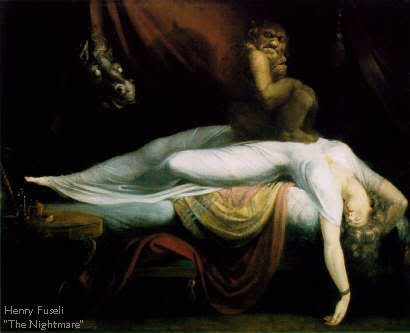
Image via Photobucket and maudlinkitten
On the actress who played Kitty Winter, she reminds me of the women found in paintings by the Pre-Raphaelite Brotherhood with pale skin and red hair.

On Baron Gruner and the material goods that define him as a man of impeccable taste and high education:
“He has expensive tastes. He is a horse fancier. For a short time he played polo at Hurlingham, but then this Prague affair got noised about and he had to leave. He collects books and pictures. He is a man with a considerable artistic side to his nature. He is, I believe, a recognized authority upon Chinese pottery and has written a book upon the subject.”
His knowledge on the aforementioned pottery:
He was standing at the open front of a great case which stood between the windows and which contained part of his Chinese collection. He turned as I entered with a small brown vase in his hand.
“Pray sit down, Doctor,” said he. “I was looking over my own treasures and wondering whether I could really afford to add to them. This little Tang specimen, which dates from the seventh century, would probably interest you. I am sure you never saw finer workmanship or a richer glaze. Have you the Ming saucer with you of which you spoke?”
“Might I ask you a few questions to test you? I am obliged to tell you, Doctor–if you are indeed a doctor–that the incident becomes more and more suspicious. I would ask you what do you know of the Emperor Shomu and how do you associate him with the Shoso-in near Nara? Dear me, does that puzzle you? Tell me a little about the Nonhern Wei dynasty and its place in the history of ceramics.”
On the Granada series, I am glad they made Watson more pro-active and created some great tension between him and Gruner. If you ask me, the original scene with Gruner testing the doctor on pottery felt very anti-climactic and rushed.
On the Baron’s betrothed, Violet:
“I don’t quite know how to make her clear to you, Watson. Perhaps you may meet her before we are through, and you can use your own gift of words. She is beautiful, but with the ethereal other-world beauty of some fanatic whose thoughts are set on high. I have seen such faces in the pictures of the old masters of the Middle Ages. How a beastman could have laid his vile paws upon such a being of the beyond I cannot imagine.”
I think Doyle may have mixed up the terminology. Up until now, I have never encountered a categorization of Middle Age artists as “old masters“. Perhaps Doyle meant early Renaissance era painters such as Sandro Botticelli.

Of course, I could be wrong and these examples could represent what Doyle meant.
Watson’s crash course in Chinese pottery:
“It is said that the barrister who crams up a case with such care that he can examine an expert witness upon the Monday has forgotten all his forced knowledge before the Saturday. Certainly I should not like now to pose as an authority upon ceramics. And yet all that evening, and all that night with a short interval for rest, and all next morning, I was sucking in knowledge and committing names to memory. There I learned of the hall-marks of the great artist-decorators, of the mystery of cyclical dates, the marks of the Hung-wu and the beauties of the Yung-lo, the writings of Tang-ying, and the glories of the primitive period of the Sung and the Yuan. I was charged with all this information when I called upon Holmes next evening. He was out of bed now, though you would not have guessed it from the published reports, and he sat with his much-bandaged head resting upon his hand in the depth of his favourite armchair.”
Bait in the form of fine China.
He opened the lid and took out a small object most carefully wrapped in some fine Eastern silk. This he unfolded, and disclosed a delicate little saucer of the most beautiful deep-blue colour.
“It needs careful handling, Watson. This is the real egg-shell pottery of the Ming dynasty. No finer piece ever passed through Christie’s. A complete set of this would be worth a king’s ransom–in fact, it is doubtful if there is a complete set outside the imperial palace of Peking. The sight of this would drive a real connoisseur wild.”
For everyone up to date in their watching of Sherlock Holmes adaptations, Sherlock would later use Chinese pottery for the episode The Blind Banker.
 Art History Ramblings