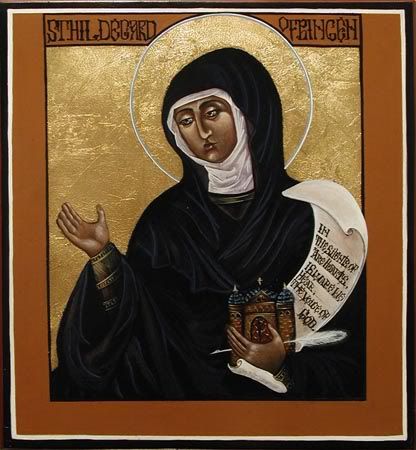
Image via Photobucket and Tempusfugit


As we approach the end of Women’s History Month and my personal Hildegard of Bingen themed month, I would like to review Secrets of God, an anthology of excerpts from the mystic’s books as translated by Sabina Flanagan.
Having watched Vision and read Hildegard’s own words, one cannot help but contemplate where Hildegard stood on the feminist/women’s rights spectrum. In the introductory chapter, Sabina Flanagan discusses this in a pragmatic way of saying, “While you may admire her for her seemingly Feminist ambition, keep in mind she did not fully pursue Women’s rights.” ETA: In fact, when I first learned about Hildegard in undergrad, the lecturer gave a caveat to students about putting Medieval women under the Feminist label. While she had her own abbey, wrote books, composed songs, and practiced wrote about medicine, she still reinforced rather backwards values. She still wrote about the fall of humanity thanks to the sin of women from the writings featured. Did Hildegard ever feel that she lived in a state of contradiction? After all, medieval writer Christine de Pisan criticized the patriarchy more than Hildegard did. In the last chapter which has various letters of correspondence to other religious authorities, Hildegard’s writings range from depicting herself as a flawed sinful woman beleaguered by her role as prophet to a person who criticizes others with the use of scripture. With that, Hildegard uses scripture constantly as a way to back her writings up.
On Flanagan, she does well in translating the abbess’ writings. She depicts Hildegard’s vision that show their fantastic nature. When it came to medicine, Flanagan reveals the intelligence and respect the abbess had towards nature. She captures the compassion that Hildegard had when practicing and taking care of patients. Another example of the abbess’ kindness comes from her in marriage counseling. There, she extolls the virtues of agreement for couples who want to make a relationship last. Also, she translates Hildegard in an easy way without a lot of dense vernacular. In short, Flanagan’s selections of Hildegard’s writings give the reader a fully rounded person.
ETA: Wanted to clarify a sentence.
 Art History Ramblings