Update 2/1/26 Due to Hubpages shutting down, I am moving my articles back to this blog. I have reorganized photo embeds and fixed any errors.
Introduction
The book Beyond Belief: Eight Strange Tales of The Otherworld is a science fiction anthology published in the 1960s that I bought years ago but never sat down to read. A few of the short stories rely on the “It’s a cookbook!” style ending.
A who’s who of science fiction
This book contains the big names such as Isaac Asimov and Arthur C. Clarke.
Reading, I also found quite a substantial amount of art history references, particularly in Evelyn E. Smith’s tale known as The Hardest Bargain.
Now, if you do not wish to be spoiled, I recommend reading this story before going further into my analysis.
“The Hardest Bargain” by Evelyn E. Smith
Moving ahead, The Hardest Bargain is Smith’s futuristic take on the Pied Piper of Hamelin fairy tale. Only instead of children being taken as a consequence of not paying a contractor money, robot servants were taken because an alien visitor (named Foma) was denied a desired collection of paintings. Additionally, instead of a German village, the story takes place in America, particularly Washington, D.C., and the problem is food shortage instead of a rat problem. In Smith’s story, Earth, in the grand scheme of outer space, is depicted as a backwater and is isolated with the exception of a few outer space tourists who want trifles.

“The Paul Revere Silver Collection”
Daderot, Public domain, via Wikimedia Commons
The story also showcases a bevy of art practically designed to stimulate an art history lover’s brain. To begin, this story mentions Paul “Midnight Rider” Revere’s work made from his Silver Shop. Foma acquires a few of Reveres’ dishes, and the picture I embedded above this paragraph has an example of his work.
And what were the other artworks Foma wanted? Keep scrolling.

Old Woman Trimming Her Nails
Rembrandt, 1655-60
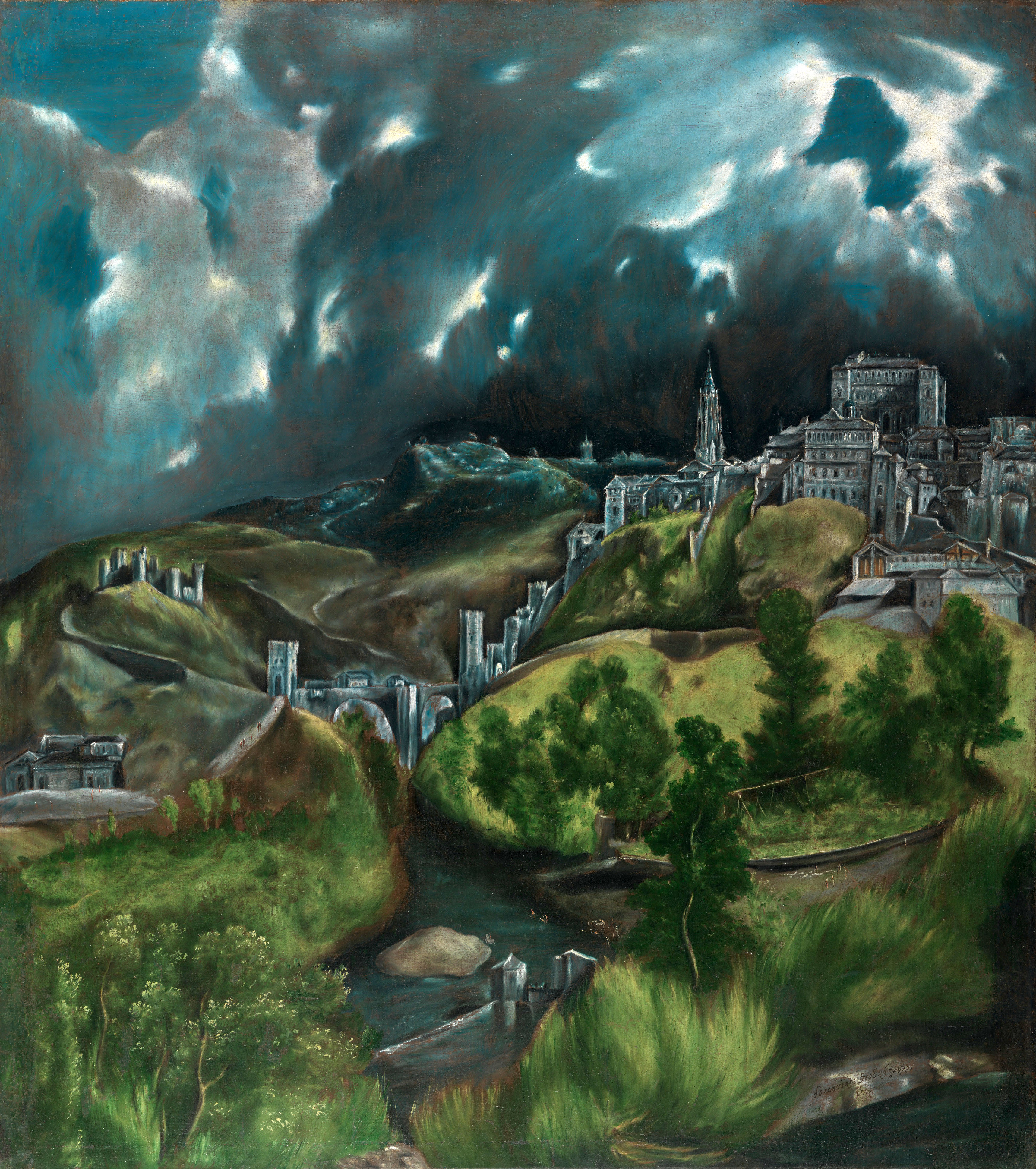
“View of Toledo” by El Greco 1596-1600 Metropolitan Museum of Art
[Public domain], via Wikimedia Commons

“Venus and Adonis” by Titian 1554 Museo del Prado
[Public domain], via Wikimedia Commons

“The Third-Class Carriage” by Honoré Daumier 1860-1863 Metropolitan Museum of Art -1923
[Public domain], via Wikimedia Commons

“Manuel Osorio Manrique de Zuñiga” by Francisco Goya 1787-1788 Metropolitan Museum of Art -1923
Francisco Goya, Public domain, via Wikimedia Commons

“The Card Players” by Paul Cézanne 1890-92 Metropolitan Museum of Art -1923
[Public domain], via Wikimedia Commons
The last pick
Instead…
I think the Rembrandt is my favorite and I understand why Foma picked these works. Foma probably had an art history book similar to the Gardner textbooks. With a couple exceptions, the art history books I have read and the general art history classes I have been to, these works are familiar to me.
After receiving Foma’s requests, the president and others decide and debate over the value of art and show disdain over foreign art. Furthermore, they discuss an art’s worth by noting the concept of pure aesthetics versus function, and this includes another mention of Revere’s silversmith fineries.
The president’s aides decide to secretly give Foma different paintings. Why, you wonder? There is a reason, and it is that the Americans fear that the Foma’s choices may give Earth a bad reputation. Now, if you went through the first selection I embedded, you will see that the Foma’s chosen paintings contain a variety of different subject matters involving mythology, nobility, entertainers, and working class people.
The second collection is a touch different.
The Substitutes

“Wivenhoe Park, Essex” by John Constable, 1816 National Gallery of Art, Washington, D.C.
[Public domain], via Wikimedia Commons

“Yonker Ramp and his Sweetheart” by Frans Hals, 1623, Metropolitan Museum of Art, New York

“My Old Kentucky Home” by Eastman Johnson, 1870, High Museum of Art, Atlanta, Georgia
By Eastman Johnson [Public domain], from Wikimedia Commons

“A Game of Hot Cockles” by Jean-Honoré Fragonard, 1775-1780, National Gallery of Art, Washington, D.C.
[Public domain], via Wikimedia Commons

“Jacob and Rachel at the Well” by the Circle of Bartolomé Estéban Murillo. 17th Century,
Dulwich Picture Gallery, Public domain, via Wikimedia Commons
Instead…
I think the Rembrandt is my favorite and I understand why Foma picked these works. Foma probably had an art history book similar to the Gardner textbooks. With a couple exceptions, the art history books I have read and the general art history classes I have been to, these works are familiar to me.
After receiving Foma’s requests, the president and others decide and debate over the value of art and show disdain over foreign art. Furthermore, they discuss an art’s worth by noting the concept of pure aesthetics versus function, and this includes another mention of Revere’s silversmith fineries.
The president’s aides decide to secretly give Foma different paintings. Why, you wonder? There is a reason, and it is that the Americans fear that the Foma’s choices may give Earth a bad reputation. Now, if you went through the first selection I embedded, you will see that the Foma’s chosen paintings contain a variety of different subject matters involving mythology, nobility, entertainers, and working-class people.
The second collection is a touch different.
Research difficulties and what happens when you care more about your reputation.
There were other paintings that were on the list of substitutes. One was called
The Arab Tax Collector by Eugène Delacroix, and the other was called Vegetable Garden by Il Canaletto, a person more known for his Venice paintings. Research on the former’s painting led me to learn that it went by other names and may not even be the painting Smith named (I had trouble inserting the painting in the article) and the latter I could not find at all.
These examples, from what I could find, while are not bad paintings, they are not as dramatic as the visitor’s original choices. I also noticed something else when putting together both collections of art. The second collection seems altogether much more joyful than the first collection as desired by Foma. Seeing these solidified the president’s councils’ observations that the second collection would make Earth look more pleasant. Instead of working class people in dour atmospheres (with serene smiles at best), the working class people in the second collection seem content and happy. Even the landscapes seem more idyllic. These authority figures, even after just emerging out of a food shortage courtesy of Foma, do not want to acknowledge that they, and others, lived through a horror.
My overall thoughts from reading this.
After reading the story and looking up the paintings mentioned, many thoughts went through my mind. What inspired Smith to use these paintings in her updated fairy tale? Did she come across these in books and catalogues, or did she see them in person? The story does reference the Hermitage and Washington’s own National Gallery of Art. Also, all these paintings made me wonder about who earns a place in the art history approved spotlight.
On the story itself, the stealing of the robots does not really match the potent tragedy of having your children being taken away all because of authority’s selfish behavior. Even as Smith remade the ending as found in Browning’s poem, there was no sense of destroyed morale.
By the way, the characters in Smith’s story mention the Browning poem and Foma reveals himself as the actual Pied Piper, so The Hardest Bargain acts as both a remake and a sequel.
“It’s such a beautiful day” by Isaac Asimov
In this story, the technological ideas Asimov conjures up; predicts (what I think) machines such as the Alexa. While the tale also contemplates technological inventions that create rich suburban living mixed with agoraphobia, Asimov mentions something called a “cubograph”. The descriptions reveal it as an updated version of a photograph.
“Phoenix” by Clark Ashton Smith
A nonfunctioning sun destroys Earth, and a team of scientists are sent to try to reinvigorate the sun. Smith reveals that the sun has been inactive for so long, it only survives in art, and the original context is completely gone. In the ship heading towards the star, the main character describes a machine by comparing it to Laocoön, the man who was punished by the Greek gods to being tormented by snakes. Was that intended to reference just the Greek myth, or the Greek sculpture itself?
“History Lesson” by Arthur C. Clarke
The final story of the anthology. It’s about aliens visiting an extinct Earth and trying to understand artifacts left behind in such a fashion that it reminded me of how people preserved and later recovered the Dead Sea Scrolls. The final humans preserve their art in caves, and similar to Smith’s Phoenix story, they preserve items that they have no idea what the original context was. The final line of the story will leave you laughing in twisted amusement.
When writing exposition, Clarke lists numerous Earth accomplishments and names the pyramids as one of them. While there are pyramids all over the world, he probably meant the Egyptian pyramids. What is it about that triangular shaped architecture that inspires Sci-Fi writers?
Overall thoughts
Regarding quality, the stories ranged from confusing to enjoyable to leaving one in a contemplative state. There are outdated ideas, but I was not surprised. When I finished reading Beyond Belief, I found myself thinking about how humans take pains to preserve art from destruction but are rarely able to preserve their original meaning.
 Art History Ramblings

![[Public domain], via Wikimedia Commons](https://commons.wikimedia.org/wiki/File:El_Greco_View_of_Toledo.jpg)
![[Public domain], via Wikimedia Commons](https://commons.wikimedia.org/wiki/File:Venus_and_Adonis_by_Titian.jpg)

![[Public domain], via Wikimedia Commons](https://upload.wikimedia.org/wikipedia/commons/4/4d/Cezanne_The_Card_Players_Metmuseum.jpg)
![[Public domain], via Wikimedia Commons](https://commons.wikimedia.org/wiki/File:John_Constable_-_Wivenhoe_Park,_Essex_-_Google_Art_Project.jpg)
![[CC0], via Wikimedia Commons](https://commons.wikimedia.org/wiki/File:Young_Man_and_Woman_in_an_Inn_(%22Yonker_Ramp_and_His_Sweetheart%22)_MET_DP145899.jpg)
![By Eastman Johnson [Public domain], from Wikimedia Commons](https://commons.wikimedia.org/wiki/File:Negro_Life_at_the_South_by_Eastman_Johnson,_c._1870,_High_Museum_of_Art.jpg)
![[Public domain], via Wikimedia Commons](https://commons.wikimedia.org/wiki/File:Fragonard_la_main_chaude_-_1775-80.jpg)
